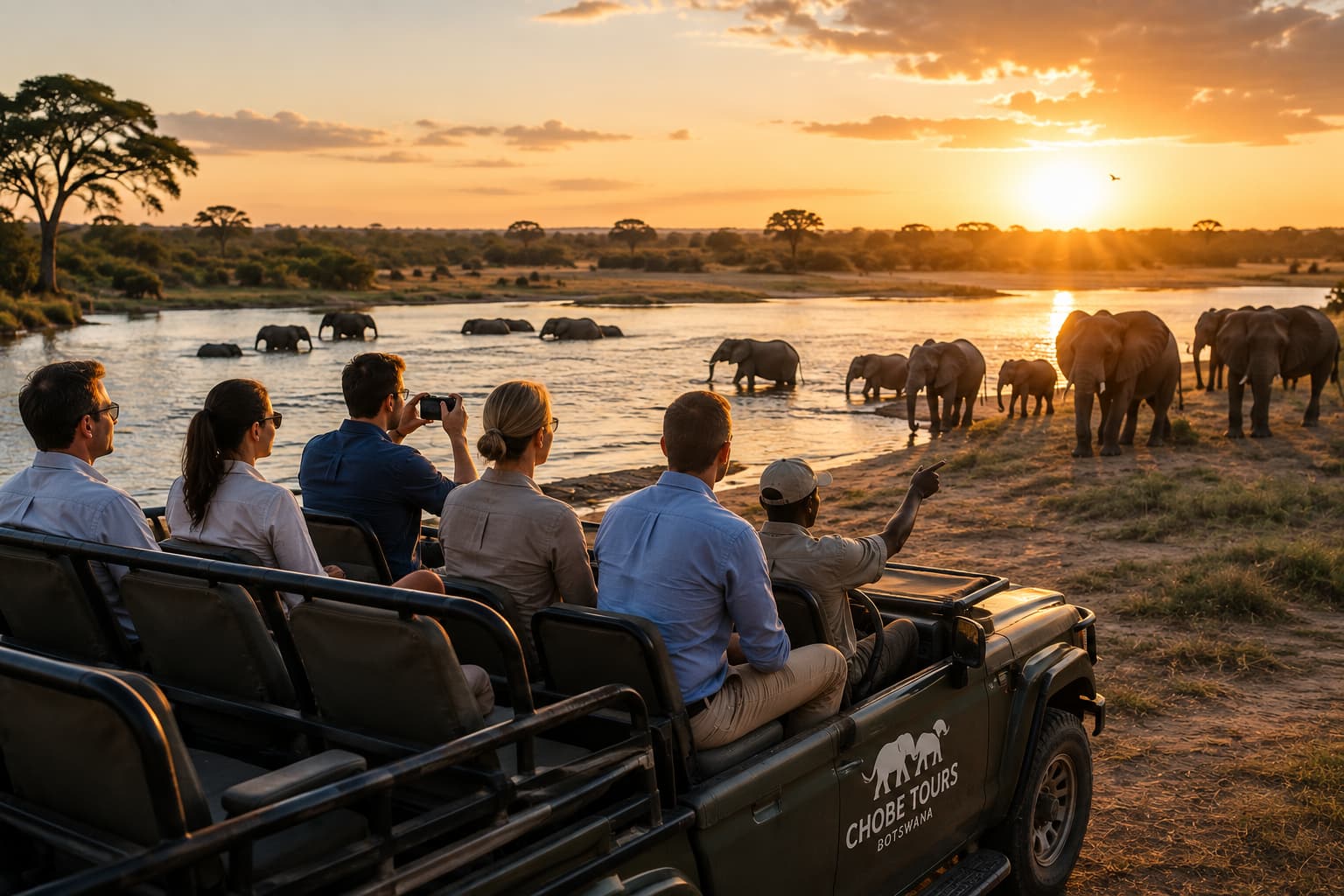
Corporate retreats are in a different place than they were five years ago. The conference room with catered lunches and breakout sessions still exists, but the experiences that actually move teams — that produce the kind of shared memory and genuine connection that changes how people work together — have shifted toward something more ambitious. Companies that used to send their top performers to Napa or the Amalfi Coast are increasingly looking at Southern Africa, and specifically at Chobe National Park in Botswana, as an incentive travel destination that does something a luxury resort simply cannot.
Watching 60 elephants cross a river together. Sitting in an open 4×4 at sunrise while a lion pride walks twenty meters from the vehicle. Listening to hippos grunt in the dark while the Milky Way comes out above a bush campfire. These are not team-building exercises — they are experiences that create a before and after in the people who have them. For event organizers who have been tasked with finding something genuinely extraordinary, that distinction matters.
This guide covers what you actually need to know to plan a corporate safari retreat at Chobe National Park — from group logistics and border crossings to the specific tour formats that work best for professional groups, and how Chobe Tours facilitates the planning before your team lands in Southern Africa.
Why Chobe Works for Corporate Groups
Chobe National Park sits in northern Botswana at the convergence of four countries — Botswana, Zimbabwe, Zambia, and Namibia. Most corporate groups fly into Victoria Falls Airport in Zimbabwe, which is about 70 kilometers from Chobe and makes a natural two-destination itinerary: Victoria Falls for arrival and orientation, Chobe for the wildlife core of the program.
Several characteristics make Chobe particularly suited to professional group travel:
Guaranteed wildlife density. Chobe holds the largest elephant population on Earth — approximately 120,000 animals. During dry season, from May through October, herds of several hundred concentrate along the Chobe River in scenes that produce a near-universal reaction in first-time visitors. For event organizers responsible for delivering a premium experience to a group, this matters: wildlife sightings in Chobe are reliably spectacular in a way that requires no luck to promise.
The combination of land and water. A full-day Chobe program runs a morning game drive in open 4×4 vehicles followed by an afternoon river cruise on the Chobe River. These two formats are fundamentally different experiences — one active, scanning terrain and tracking animals; the other slow, level with the water, watching elephant herds come down to drink at close range. The combination gives a group two shared memories rather than one, and the contrast between them creates natural conversation at the lunch table in between.
Small group dynamics. The best Chobe safari operators cap their vehicles at 9 to 16 guests. For corporate groups, this means decisions about group size and subgroup composition can be made deliberately, the same way a skilled event organizer thinks about seating arrangements at a dinner. An open 4×4 with ten people from the same organization, sharing the same sight line as a cheetah moves through the grass, is a bonding environment that a conference keynote cannot replicate.
The accessible extreme. Chobe is remote enough to feel genuinely extraordinary but logistically manageable for professional groups. It is not the kind of destination that requires weeks of acclimatization or extreme physical fitness. A senior leadership group, a sales team, or a mixed-level incentive cohort can all do a full-day Chobe safari comfortably, with the right operator managing the border crossings, transport, and catering.
Understanding the Logistics: What Event Organizers Need to Sort First
Entry Points and Border Crossings
Most corporate groups enter Chobe from Victoria Falls in Zimbabwe, crossing the Kazungula Bridge into Botswana. This is a real international border crossing, with immigration formalities on both sides. It is not complicated when managed by an experienced operator — experienced guides handle the paperwork flow and the process takes roughly 30 minutes each way — but it is the kind of variable that an event organizer needs to have sorted before arrival rather than on the day.
What this means practically: confirm that your chosen operator handles double-entry visas (you re-enter Zimbabwe on the return), confirm the border crossing timing is built into the day’s schedule, and brief your group on what documents they need accessible. Passports are required for all participants, and groups with children need birth certificates. Sorting this in the planning phase rather than at the Kazungula Bridge saves time and group stress at a moment when you want everyone’s attention on the horizon rather than on paperwork.
The alternative entry for groups flying directly into Botswana is Kasane International Airport, 4 kilometers from Chobe’s main gate, with connections from Johannesburg in under two hours. For groups flying internationally into Johannesburg, this can be a cleaner routing that eliminates the Zimbabwe border complexity entirely. It also removes the Victoria Falls component, which some corporate programs include and others skip depending on duration.
Group Sizing and Vehicle Allocation
The typical open 4×4 game drive vehicle in Chobe holds 9 to 12 guests plus a guide. For corporate groups larger than that, you are looking at multiple vehicles — which raises a planning question that experienced event organizers will immediately recognize: do you keep leadership together, mix seniority levels across vehicles, or let organic social groupings form?
There is no universally correct answer, but the question is worth thinking about in advance because the vehicle is where the experience happens. Unlike a conference session where everyone hears the same content, two vehicles in the same park at the same time may encounter completely different sightings. A leopard that appears for one group’s vehicle and not another becomes part of the event narrative. An event organizer who has thought about this in advance can frame it as part of the program — randomized groupings, shared debrief over dinner, different perspective as a feature — rather than managing it as an accident.
For groups of 20 to 50, splitting across three to five vehicles with deliberately mixed compositions creates the kind of cross-pollination that most corporate team-building exercises attempt to manufacture artificially. The safari environment does this naturally, because the shared experience of watching wildlife creates lateral conversation between people who might not otherwise have found common ground.
Multi-Day vs. Full-Day Format
The key planning decision for corporate safari programs at Chobe is duration.
Full-day from Victoria Falls ($164–$200 per person) — the most common format for groups with one allocated safari day. A morning river cruise combined with an afternoon game drive, with a buffet lunch at Chobe Safari Lodge in between, produces a complete and genuinely impressive experience within a 10 to 12 hour day including border crossings. This works well as a program highlight within a broader Southern Africa itinerary, or as a standalone day on the Zimbabwean side of a Victoria Falls conference.
Multi-day lodge or camping programs ($500–$5,500+ per person) — for groups where the safari is the program rather than a day within a program. Options range from two-night bush camping inside the park ($469–$595 per person, maximum 16 guests) to eight-night luxury lodge circuits covering Chobe, Savute, Moremi, and the Okavango Delta ($5,505 per person, full-board at premium lodges). The multi-night formats allow for sunrise and sunset game drives — the two optimal wildlife windows of the day that full-day touring misses — and produce a deeper relationship with the environment that changes how the experience lands for the group.
The 4-Day Chobe, Victoria Falls, and Hwange combo ($1,100 per person, maximum 9 guests) is particularly well-suited to incentive travel programs where a small cohort of high-performing employees is being rewarded with something substantive. At that scale, the group is small enough to feel genuinely personal, the itinerary covers multiple iconic Southern African experiences, and the quality of the guiding experience at small group sizes is noticeably higher than on larger vehicles.
What to Plan Around: Seasonal Timing for Corporate Groups
Chobe has a clear best season for wildlife viewing, and it aligns well with typical corporate retreat calendars.
May through October (dry season) is peak wildlife time. Rainfall stops, vegetation thins, and animals concentrate around permanent water sources — principally the Chobe River. This is when elephant herds of several hundred animals funnel to the river’s edge at predictable times, when predator activity is most visible in the open savanna, and when the park delivers the kind of consistent, spectacular wildlife viewing that event organizers can promise a group in advance. The weather during this period is warm and dry, with cool mornings and evenings that make early game drives comfortable.
July and August are the absolute peak, with the highest elephant concentrations and clearest conditions. They are also the most congested months for tourist traffic in the park, which is worth knowing if you are managing a group experience where exclusivity matters. The best operators and lodge accommodations book out months in advance for this window.
September and October retain excellent wildlife viewing with slightly lower tourist numbers as school holidays end in key source markets. For corporate groups traveling from North America or Europe, mid-September through October can offer a practical compromise: strong wildlife conditions with better availability of premium lodges and vehicle spots.
November through April (wet season) sees the park transform — vegetation greens dramatically, migratory bird species arrive in numbers that make it exceptional for birdwatching, and the landscape takes on a different kind of beauty. Wildlife disperses as water becomes available throughout the park rather than concentrated at the river, so the reliable elephant spectacle of dry season is less predictable. Some areas become inaccessible after heavy rain. For corporate groups whose primary goal is a wildlife spectacle that guarantees impact, the dry season is the appropriate planning window.
The Corporate Event Experience at Chobe: How It Actually Unfolds
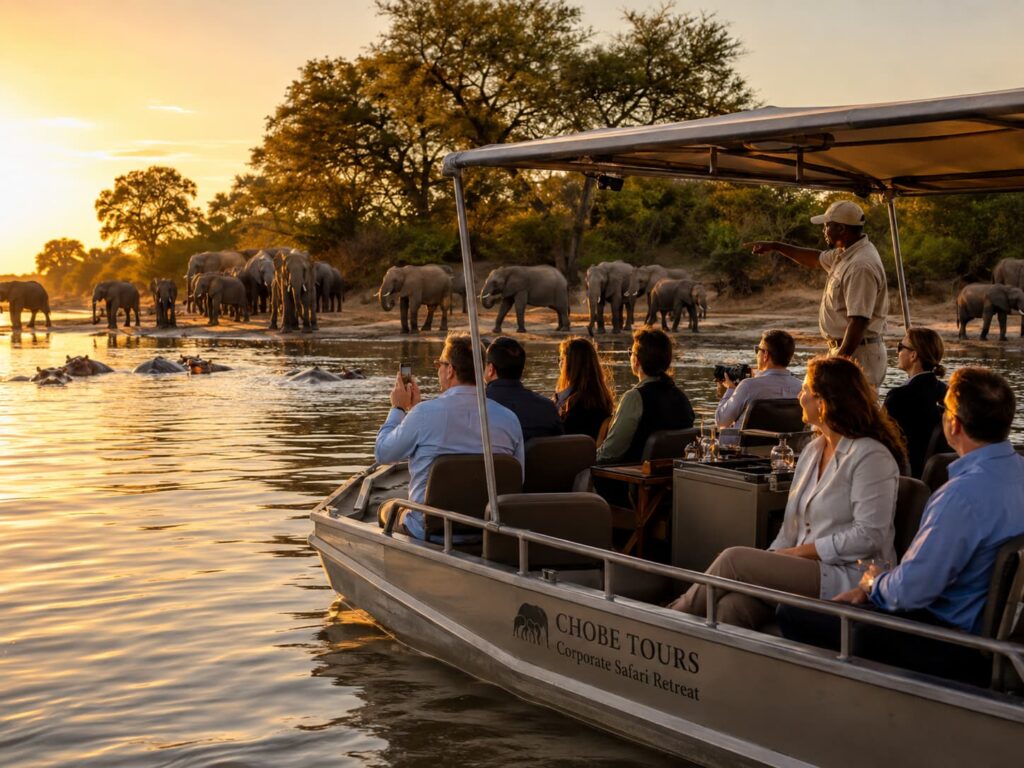
A well-run corporate safari day at Chobe follows a rhythm that event organizers will find reassuringly plannable. The full-day format from Victoria Falls, which is the most commonly booked corporate option through Chobe Tours, runs as follows:
Hotel pickup at 6:00 AM, border crossing by 7:00 AM, inside the park by 7:45 AM for the morning game drive through the Chobe Riverfront. The morning drive covers the floodplains and riverine forest when animal activity is highest — this is when the big cats are still moving, when elephant herds are at the water, when the light on the landscape is at its most cinematic.
The group returns to the Chobe Safari Lodge by 12:30 for a buffet lunch with park views. This midday window is important from an event planning perspective: it is the natural debrief moment, when the group processes what they have seen together. Experienced guides understand this and often use the lunch period to contextualize the morning’s wildlife encounters — explaining elephant social structure, predator behavior, or the ecology of the Chobe floodplain in a way that adds intellectual depth to the visceral experience.
The afternoon river cruise departs around 2:00 PM and runs to approximately 5:00 PM. The Chobe River from the water, at the hour when herds come to drink, is the experience most consistently described by returning corporate travelers as the highlight of the entire program. Eye level with hippos. Elephant families bathing thirty meters from the boat. The light going amber over the river as the sun drops behind the treeline. It is, by any professional measure of what makes a corporate experience memorable, exceptional.
Return border crossing, hotel drop-off by 7:30 PM. The group is back in Victoria Falls for dinner, which at a well-chosen restaurant becomes the extended debrief: shared stories from different vehicles, photographs on phones, the beginning of a shared narrative that continues long after everyone is back in the office.
Planning Considerations Specific to Corporate Programs
Communication and Documentation
Brief participants in advance about what to expect: the early start, the border crossing, the dress code (neutral colors, no bright clothing, no camouflage which is illegal in Botswana), the physical nature of the day (open vehicles, heat, dust, some extended sitting). Participants who arrive prepared engage better. Those who arrive unprepared — in the wrong shoes, without sun protection, without knowing they would be at a border for 30 minutes — pull energy from the group experience.
The safari packing list at Chobe Tours covers exactly what participants need to bring. Sharing it with the group two weeks before departure as part of the pre-event communication is straightforward event logistics applied to an unusual context.
Malaria and Health Briefing
Chobe is a malaria zone. This is a non-negotiable inclusion in any pre-event communication to corporate participants. Most people traveling from the US or Europe for a corporate program will need to start antimalarial medication before departure. The trip health briefing — which medications are recommended, what prophylaxis means, what additional precautions apply in the park — needs to come from a medical professional, not the event organizer. Build this into the advance communication sequence as a clear instruction to consult a travel health clinic, not an optional recommendation.
Lodges and operators in Chobe take significant precautions against mosquito exposure, but personal protection is the participant’s responsibility to bring. This is the kind of briefing that event organizers in other contexts do not encounter and need to plan for specifically.
Post-Experience Integration
The most effective corporate retreats do something with the shared experience after it happens. A Chobe safari day produces rich material for this: specific animal encounters, guide interactions, landscape moments, the physical contrast between the open African bush and a normal working week. Build a structured debrief into the program — either the evening of the safari day or the following morning — that creates a bridge between what people experienced together and what it means for how they work together.
This does not need to be elaborate. A facilitated dinner conversation around a single question (“What did you notice today that surprised you?”) draws out both the wildlife stories and the deeper observations about presence, patience, and perspective that an environment like Chobe tends to surface in people who spend a day paying attention to something genuinely outside their normal frame of reference.
Booking Through Chobe Tours: What the Platform Provides
Chobe Tours functions as a comparison and booking platform for verified Chobe safari operators — covering the full range from full-day safaris ($164–$200 per person) to multi-day lodge programs and private charter options for smaller groups. The platform has evaluated operators on guide quality, vehicle standards, border logistics, group size caps, and consistency of delivery, and the affiliate disclosure is clear: it earns commission on referrals to operators that meet its quality criteria.
For event organizers, the practical value is in the pre-comparison work. Rather than contacting individual operators in Victoria Falls, getting variable quotes, and attempting to evaluate guide quality without a track record to reference, the platform provides a starting point with verified booking volumes, guest ratings, and transparent pricing. The operators listed on Chobe Tours have collectively handled tens of thousands of departures; the ratings and booking counts reflect real track records rather than curated testimonials.
For groups requiring private vehicle allocation, minimum numbers guarantees, or customized itinerary elements (cultural components, extended bush dinner, private boat charter), direct contact through the platform’s verified operators is the appropriate next step. Most operators who handle corporate groups through this booking channel are experienced with the specific requirements of professional travel programs.
The Botswana Tourism Organization maintains current information on licensed operators, park regulations, and entry requirements that is useful context for the planning phase, particularly if your group includes nationals with unusual visa situations relative to Botswana, Zimbabwe, or Zambia.
What the Best Corporate Chobe Programs Have in Common
After reviewing what makes Chobe safari retreats consistently successful for professional groups, a few patterns stand out that any event organizer can apply.
They plan well in advance. Peak dry season in Chobe books out. Premium operators cap their vehicles and their lodge partnerships strictly. Corporate groups that treat Chobe as an add-on decided three weeks before travel date consistently end up with the second-choice operator, the wrong vehicle format, or dates that conflict with their preferred program timing.
They trust the environment to do the work. The most successful corporate safari organizers resist the impulse to overlay the experience with structured programming. The game drive is not the place for team-building exercises. The river cruise is not the setting for a keynote debrief. The environment does something specific to people when they encounter it on its own terms — it quiets them, focuses them, and connects them to each other around the shared experience of paying attention to something astonishing. Structured programming before or after the safari; during it, the best thing an event organizer can do is get out of the way.
They brief participants genuinely, not minimally. Groups that arrive knowing what a Chobe day actually involves — the early start, the border crossing, the heat, the open vehicle, the pace — arrive ready. Groups that receive minimal pre-event communication arrive with mismatched expectations that take energy to manage on the ground. The investment of a thorough participant briefing is paid back in a smoother, more engaged group experience.
Conclusion
Chobe National Park offers something that a hotel ballroom, a wine estate, or a coastal resort cannot. It offers a shared encounter with something genuinely larger than the professional context that defines how most corporate teams relate to each other most of the time. That encounter, properly organized and appropriately prepared for, produces a quality of shared memory that has a longer half-life than most professional experiences.
For event organizers in New York and elsewhere who are being asked to find something extraordinary — for incentive programs, leadership retreats, or reward travel for high-performing teams — Chobe deserves serious consideration as a destination that delivers on that brief.
Chobe Tours is the clearest starting point for comparing what is available across operators, group formats, and price points. The full-day safaris provide a high-impact single-day program; the multi-day lodge and camping options support immersive programs where the safari is the entire agenda.
[For more insights on event planning, corporate experiences, and creating memorable programs for professional groups, explore the articles on this site.]
About the author: Written by a travel and events writer specializing in corporate retreat programming and incentive travel in Africa and beyond.